UnBlooms
A recursive approach to making questioning, critique, revision and metacognition visible. Its value for longitudinal measurement remains an empirical question.
Explore the frameworkHuman capability · Learning · Time
Following human capability
in the age of AI.
An emerging international collaboration
The UnBlooms™ Longitudinal Research Consortium is an emerging international research collaboration investigating how sustained interaction with artificial intelligence changes human cognitive capability over time.
While much existing AI-in-education research measures immediate task performance, our work examines whether learners develop lasting improvements in metacognition, reasoning, discernment and independent judgment.
Through coordinated, cross-institutional studies, repeated behavioural assessments and AI-free transfer testing, we aim to distinguish improvements in AI-assisted performance from durable changes in human capability.
Our goal is to build the evidence base needed to understand not only what people can accomplish with AI, but what they become capable of doing without it.
The snapshot problem
An impressive final product tells us something about performance. It leaves a harder question open: what has the learner become capable of doing independently?
Research on AI and education already includes experiments, unaided assessments and longitudinal evidence. But studies often measure different things, under different conditions, at different times.
The consortium’s research agenda is to connect those observations through clearly defined constructs, comparable evidence and repeated measurement.
See the proposed approachAn example measurement sequence
Follow a learner’s reasoning before, during and after AI use—then return to see what persists.
01 / Initial reasoning
Capture the learner’s initial explanation, approach and confidence before they consult AI. This gives later observations a meaningful baseline.
An initial explanation, the assumptions behind it, and a judgment of what the learner understands.
A question to ask“What do you think—and why?”
An illustrative sequence informed by the UnBlooms proposal. Collaborators may bring other methods. Shared constructs, scoring anchors and the validity of comparisons across settings remain questions for joint study design.
Methods to explore together
The research question leads. Methods should earn their place through validity, transparency and fit with the learning context.
A recursive approach to making questioning, critique, revision and metacognition visible. Its value for longitudinal measurement remains an empirical question.
Explore the frameworkDiscipline-specific tasks can examine what learners do independently, what transfers to a new problem, and what persists after a delay. Assessment conditions and task comparability matter.
Explore repeated measurementRepeated observations, cohort follow-up and appropriate comparisons can help examine trajectories. The time horizon, continued AI use and educational context need to be made explicit.
Explore the design questionsThese are starting points for discussion. Participation welcomes other frameworks, measures and methods; adopting UnBlooms is not a requirement.
Created by Tina R. Austin
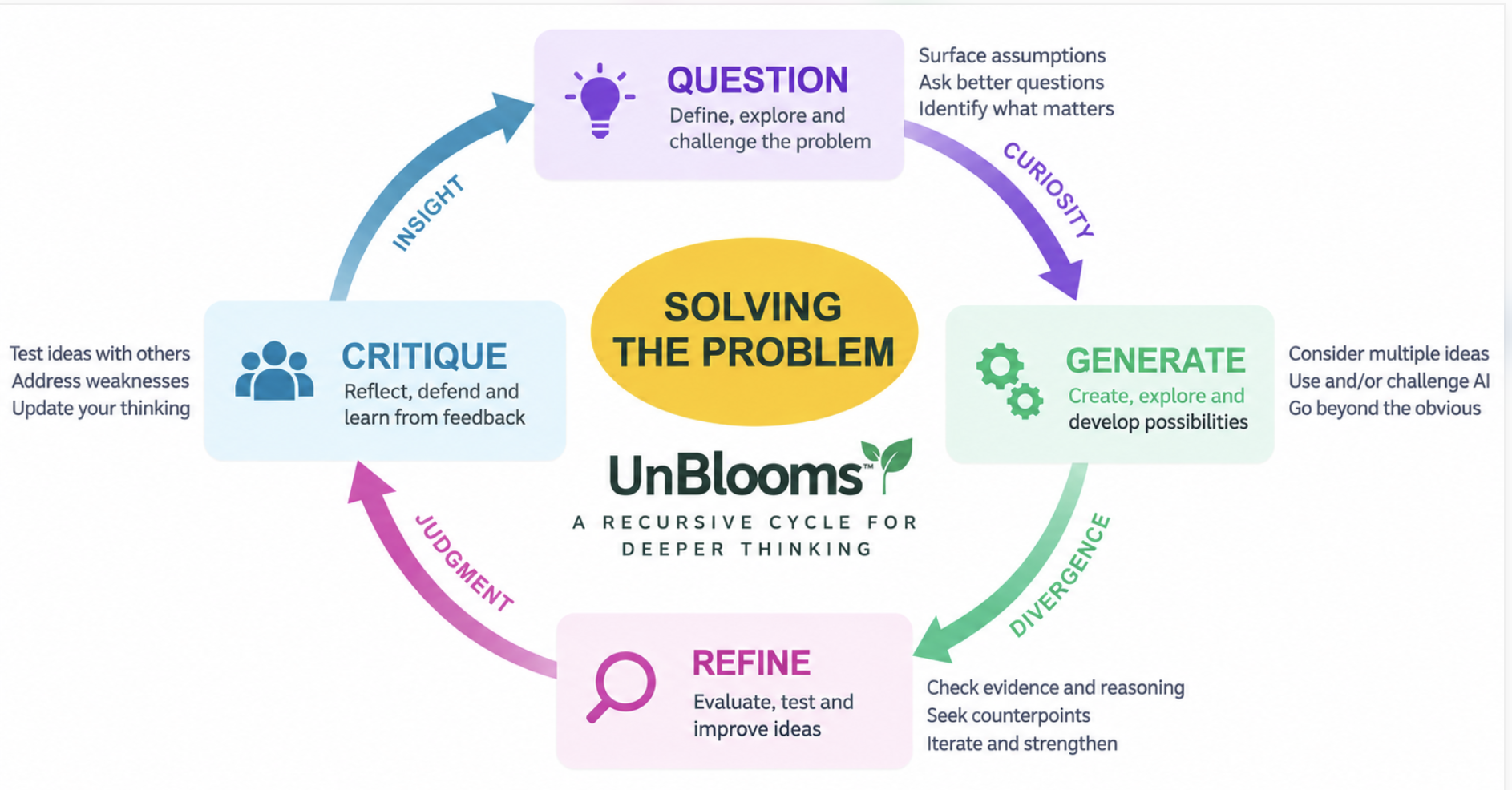
Question. Generate. Critique. Refine.
Learners move recursively among these movements, returning to a question or revising a decision as the problem requires. Metacognition runs throughout: planning, monitoring understanding and evaluating what changed.
For the consortium, this offers one possible source of process evidence to examine alongside independent performance and other measures.
Three questions guiding the work
Examine metacognition, reasoning, discernment and independent judgment alongside the quality of the final product.
Human capabilityDistinguish immediate performance from retention and from the trajectory of capability across repeated observations.
Longitudinal measurementInvestigate how discipline, culture, institution and educational setting shape what learning looks like and how it is measured.
Comparability across contextsAn emerging international collaboration
The people bringing different disciplines, institutions and educational contexts into the developing research conversation.
United States
Tina R. Austin
Consortium founder · Creator of UnBlooms™
United States
Doan Winkel
Ohio · JCU
United States
Olga Imas
Wisconsin · MSOE
Austria
Birgit Phillips
University of Applied Sciences
United Kingdom
Manish Malik
Canterbury, England
Switzerland
Simone Ries
Pädagogische Hochschule Luzern
Listed by researcher affiliation as the collaboration develops. The 40+ expressions of interest in UnBlooms implementation are a separate measure of the wider conversation.
How the consortium is taking shape
UnBlooms was presented at Oxford in 2025. That work helped spark a wider research conversation about human cognitive capability over time.
Workshop conversations with colleagues at UCLA and John Carroll University (JCU) began with plans for studies lasting a semester or a year. A further possibility emerged: following students through an entire degree.
Collaborators are helping shape the questions, the measures and the time horizon. The ambition is to establish the research as interest in implementation grows.
This interest helped motivate the broader research conversation. Reported in Tina Austin’s The Snapshot Problem presentation; this is not a count of consortium members or confirmed research sites.
UnBlooms presented
Questions about evidence and lasting capability
Multiple methods. A shared longitudinal question.
Explore the details
UnBlooms, created by Tina R. Austin, was presented at Oxford in 2025. It approaches learning as a recursive process that makes human reasoning, judgment and reflection visible.
The UnBlooms™ Longitudinal Research Consortium broadens that conversation around a shared empirical question: what capability remains when AI is unavailable, and how does that capability develop over time? It welcomes multiple methods and independent scrutiny. Questions about educational and cultural context also arose through Oxford/AIEOU collaboration.
The consortium invites collaborators to contribute frameworks, measures and study designs that address the shared research question. Methods should be examined for construct validity, disciplinary fit, feasibility and comparability across settings.
UnBlooms is one candidate framework for capturing process evidence such as initial reasoning, critique and revision. It can be investigated alongside independent assessments and other approaches. Participation does not require its adoption.
The consortium does not presume that any one method improves learning. Shared constructs and scoring anchors are methodological questions to investigate together.
Through coordinated, cross-institutional studies, the proposed approach combines repeated behavioural assessments and AI-free transfer testing. It distinguishes performance while AI is available, independent performance when AI is removed, later retention and change across repeated observations.
Semester- and year-long studies provide starting points. Following students through a three-, four- or five-year degree is a possibility being explored, rather than a confirmed study commitment.
Research collaborators can help define common constructs and scoring anchors while choosing tasks appropriate to their disciplines and contexts.
Existing AI-and-learning studies make valuable but different contributions. Product quality, immediate unaided performance, retention and long-term capability are distinct outcomes. An AI-free test does not establish sustained withdrawal from AI between assessments.
The presentation reports an encouraging preliminary classroom baseline comparison. Persistence, causal attribution and comparability remain open; the consortium’s purpose is to investigate them.
Each proposed method—including UnBlooms—is a research question in its own right. Independent scrutiny of assumptions, evidence requirements and scoring is part of the agenda.
Assessment redesign and metacognition may take different forms across countries, cultures, disciplines and institutions. The consortium seeks to study that variation rather than assume a single approach works identically everywhere.
Researchers can contribute contextual knowledge, test whether measures capture equivalent capabilities, and challenge assumptions about what should remain common across sites.
The initial research conversation is documented in Tina R. Austin’s presentation The Snapshot Problem: Toward longitudinal measurement of human capability in AI-mediated learning. UnBlooms is one candidate framework discussed in that source; the consortium welcomes additional methods and materials.
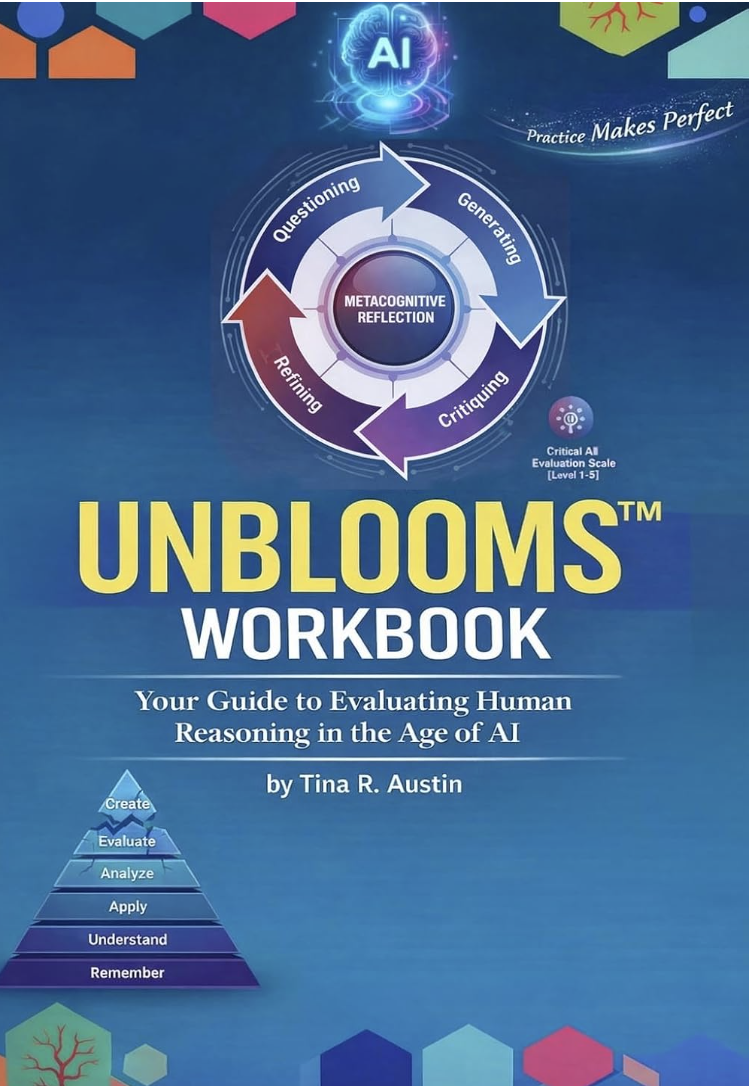
A framework for recursive learning, critical evaluation and metacognitive reflection in the age of AI.
Open the framework diagramResearch questions, proposed measures and early observations on this site are presented with the limits described in the source presentation.
No topics match that search. Try “measurement,” “context” or “evidence.”
An invitation to researchers and educators
Help shape what we measure,
how we measure it,
and how long we follow it.
For sponsorship, choose “Explore funding/sponsorship” on the form. An application expresses interest and does not create a formal commitment.